


AI and infrastructure news
nginx built with --with-libatomic on ARM loses updates and refuses new visitors
On 14 October 2026, a production nginx on an ARM server started to refuse every new visitor with error 429. The cause is the --with-libatomic build option. The test, the patch and the fix are on GitHub.
Granite Switch 4.1: chat, decisions and speech from one endpoint
On October 15, 2026, IBM published Granite Switch 4.1, in 8B and 30B versions, combining chat, decision and safety adapters and a speech recognition model while using about the same GPU memory as the base model.
Intel LLM-Scaler-vLLM 1.5: more up-to-date inference on Intel Arc GPUs
On October 16, 2026, Intel released version 1.5 of LLM-Scaler-vLLM, a Docker stack with vLLM for Intel Arc GPUs, which jumped from vLLM 0.14 to 0.26 and added more models and FP8 quantization.
Nemotron 3.5 Super VL: an open model that reads documents, images and video
On October 15, 2026, NVIDIA released Nemotron 3.5 Super VL, with 120B parameters and 12B active, open weights, data and recipes, text, image and video input and up to 1 million tokens of context.
TranscribePsy: on-device speech recognition, including Portuguese
On October 14, 2026, Tether AI Research released TranscribePsy, a 254M-parameter speech recognition model that runs on a phone or laptop without the audio leaving the device.
- AI agentsPaper
Autonomous science limited by physical validation: allocating agents and validation bottlenecks
An arXiv paper argues that autonomous science is limited by physical validation capacity and proposes markets and institutions to allocate that scarce work.
- Reinforcement learningPaper
QwenGyre: elastic RL for training long-horizon agents
Alibaba Qwen presented QwenGyre, an elastic RL framework that reallocates GPUs between rollout and training and groups branched agent runs into trajectory trees with shared prefixes, with a reported speedup of up to 1.85x over Colocate.
- LLM inferenceArticle
Intel GPU D-Series: inference card with up to 480GB LPDDR5X now sampling
Intel has presented the D-Series GPU, with up to 480GB of LPDDR5X, 1.5TB/s and 1.3 PFLOPS in FP8 on a 350W PCIe card now sampling. See what it changes for private inference and cost per token.
- Attention and model architectureProject
μLattice: an alternative to attention for memory scaling, according to its author
An open-source project and paper describe μLattice, a memory design that grows with input without quadratic cost. The performance claims come from the author and have not been independently verified.
- Speech: TTS and ASRPost
Artificial Analysis: HeyGen Voice tops controlled voice TTS ranking
Artificial Analysis ranked HeyGen Voice first in the Controlled Voice TTS Arena, with an Elo of 1,201 across 8 cloned voices in US and UK English, ahead of competing commercial voice models.
- AI agentsPaper
HERMES: component-level harness with a resident LLM per code module
An arXiv paper proposes HERMES, where each repository component has a resident LLM that knows its code, with reported gains in migration and on four software engineering benchmarks.
- Training and fine-tuningPost
Social media post on RoboJEPA: predictable scaling in robotic world models
A social media post describes RoboJEPA, an 8B-parameter JEPA world model trained on 15,022 hours of robot video, and scaling-law fits that anticipate the results of the 4B and 8B models.
- Speech: TTS and ASRModel
Qwen3-TTS 1.7B: open-source voice cloning with emotion and accent controls
The post presents an open-source 1.7B text-to-speech model for voice cloning, with controls for emotion, age, tone and accent, plus multilingual support. For companies, a self-hosted evaluation means checking license, languages and controls before any use.
- Speech: TTS and ASRModel
Whistle: 16.9 MB speech-to-text model built for on-device use
Cactus-Compute published Whistle, a 16.9 MB speech-to-text model for on-device use. The author claims it rivals Whisper base. For companies handling sensitive audio, the announcement opens a case for local transcription.
- Speech: TTS and ASRPost
Voice clones of non-native English speakers rated more human: what it means for companies
A NeurIPS 2026 paper cloned the voices of 86 non-native English speakers using three voice-synthesis systems. In 4,000 human ratings, the clones were judged warmer, more authoritative and more human, which raises trust risks for voice channels.
- AI agentsPost
DeLM: decentralized code agents with shared context, without a central coordinator
Stanford's article presents DeLM, which replaces a central coordinator with shared context and a task queue. According to the author, it is up to 2.49× faster and more accurate than the Claude Code and Codex baselines.
- Training and fine-tuningArticle
LayerRoPE: encoding depth in normalization weights for very deep Transformers
The paper proposes LayerRoPE, which encodes depth in normalization weights to contain the growth of hidden-state norm across layers, reporting the loss of a 1.3B Pre-Norm model with 3.4x less compute and stable scaling up to 512 layers.
- Training and fine-tuningPaper
RoboJEPA: how scaling JEPA world models affects robotic planning
Meta presented RoboJEPA, a latent world model based on JEPA, scaled from 22M to 8B parameters and trained on data from 12 robotic embodiments. The paper tests whether latent prediction error predicts later planning performance.
- LLM inferencePost
Samsung opens LittleBit, a method that compresses 13B LLMs to under 1 GB
According to the post, Samsung's LittleBit uses latent factorization and sub-1-bit levels to shrink the weights of 13B LLMs to under 1 GB. Worth evaluating for local deployment.
- Speech: TTS and ASRArticle
Multilingual speech-to-text benchmark for local models in transcribe.cpp on a notebook
Site comparing accuracy and speed of speech-to-text models supported by transcribe.cpp, measured per language on FLEURS, with performance data from a notebook CPU/GPU (4750U).
- Training and fine-tuningArticle
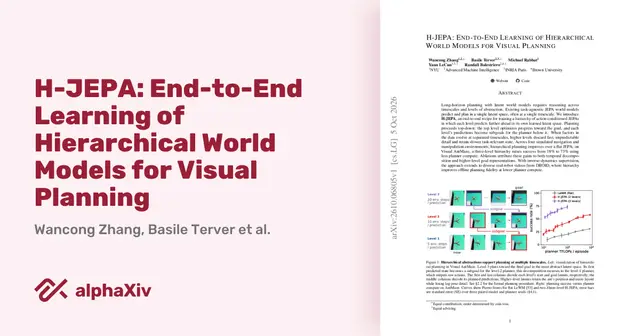
H-JEPA: hierarchical world models for long-horizon visual planning
The article, guided by Yann LeCun, proposes H-JEPA, with JEPA world models stacked across multiple time scales. The author reports a rise from 18% to 73% on Visual AntMaze with this hierarchical approach.
- Attention and model architectureArticle
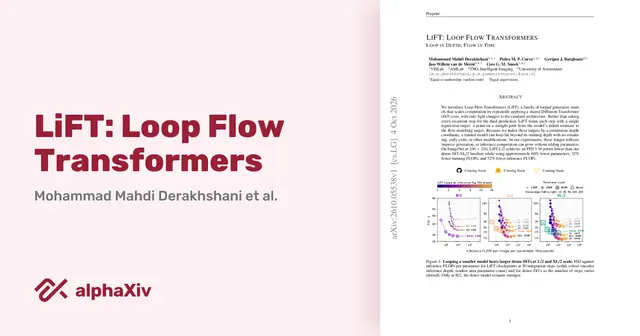
LiFT: looped transformers for image generation with flow matching and adjustable inference cost
The paper presents LiFT, an image generator with flow matching that reuses a shared transformer core across loops. According to the author, a model trained with 2 loops improves when run with up to 16 loops at inference, without retraining.
- RAG and retrievalPost
Quantizing 10M EmbeddingGemma vectors to 1 bit with MRL cuts RAM from 30GB to 0.4GB
The author's post reports compressing 10 million EmbeddingGemma embeddings to 1 bit, with MRL reduction to 256 dimensions, dropping RAM from about 30GB to 0.4GB at a stated quality loss of about 5%.
- Training and fine-tuningPaper
Memory-Efficient Expert Routing for Distributed MoE Training
The arXiv paper proposes methods to reduce the memory peak in distributed Mixture-of-Experts training, where expert dispatch dominates memory use.
- Speech: TTS and ASRPost
Single-voice 9MB TTS model distilled from Kokoro-82M for local voice output
A post describes a single-voice, single-language text-to-speech model of about 9MB of weights, distilled from Kokoro-82M and aimed at local voice output on resource-constrained devices.
- SecurityProject
Collection on Linux kernel security and exploitation updated with January and February entries
The collection on Linux kernel exploitation was updated with January and February links on kernel security. For infrastructure teams, it points to the need to track this topic in a systematic way.
- OCR and document AIArticle
Choosing and deploying open OCR models in your own pipelines
The post from an open-model platform's blog covers how to choose an OCR model, compare leading models, deploy locally or remotely, and go beyond OCR.
- Training and fine-tuningProject
Unsloth notebooks for fine-tuning and RL across model types
The Unsloth repository gathers more than 250 notebooks for fine-tuning and RL on text, vision, audio, embedding and TTS models, serving as examples of training workflows.
- C and C++Article
Wikibooks reference gathers over 80 C++ design patterns
The community-maintained More C++ Idioms reference on Wikibooks collects over 80 C++ design patterns for engineers to explore and compare. Companies can use it as a baseline for internal coding standards.
- SecurityPost
Prompt injection vectors: how to test and harden AI systems
The post gathers prompt injection vectors and strategies with examples, useful for assessing and hardening the security of applications built on language models.
- C and C++Project
WinDbg MCP exposes Windows debugger functions as MCP tools
The post describes WinDbg MCP, an MCP server that makes Windows debugger functions, via pybag, available to compatible clients for inspecting running processes and crash dumps, setting breakpoints, reading memory and walking the stack.
- HardwareArticle
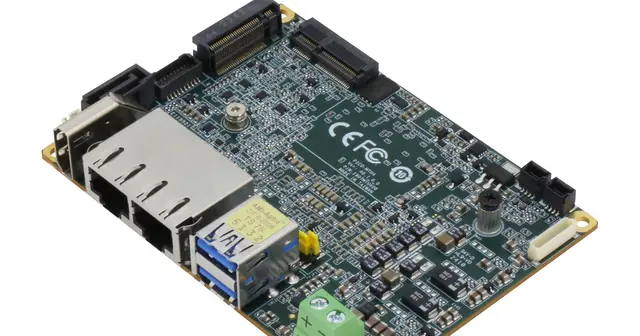
AAEON presents Pico-ITX board with Core Ultra and up to 32 GB
On November 7, 2025, AAEON presented the PICO-ARU4, a compact board with Core Ultra processors, soldered LPDDR5 memory, and connections for embedded systems.
- Reinforcement learningPaper
Adapting models to Q, a language used in finance
A technical report dated January 9, 2026 presents an open-source approach to adapting language models to Q, a programming language used in quantitative finance.
- C and C++Paper
ADRS explores automated systems performance research
Published on December 24, 2025, the paper presents a framework that uses language models to generate, evaluate, and refine algorithms, tested on ten tasks across networks, databases, and distributed systems.
- AI agentsPaper
Agent-R1: modular training for multi-turn LLM agents
The paper presents a reinforcement-learning framework for training LLM agents in multi-turn interactions with tools and sequential environments.
- AI agentsPost
Auditable self-improving agents
An article published on April 19, 2026 proposes a protocol for agents to suggest, evaluate, and implement improvements with auditable traceability and rollback.
- Reinforcement learningPaper
Search agents can check evidence against noise
Published on October 28, 2025, the paper describes an agent that sets search goals and checks whether retrieved evidence meets them, aiming to resist misleading cues.
- AI agentsPost
Code agents: evaluating safety and performance
Microsoft reports a 14-billion-parameter coding agent scoring 45.3% on SWE-Bench Verified, and a training method that accounts for tests unintentionally broken while adding features.
- AI agentsPost
Recursive agents exchange latent states to collaborate
A May 1, 2026 publication describes a paper on agents refining shared latent states and reports more precise collaboration, faster execution, and lower token use in experiments.
- Reinforcement learningPost
Fine-tuning a 14B code model with SFT and DPO
A January 20, 2026 article describes tuning a 14B model on code conversations and reports figures, costs, and difficulties.
 arxiv.org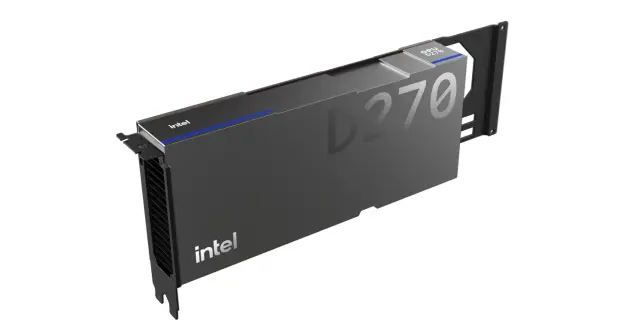


Let's assess your project

I reply with scope and a proposal.