


AI and infrastructure news
- Attention and model architecturePaper
Looped Transformers: reducing redundancy and cost
A paper published on September 26, 2026, identifies three types of computational redundancy across loops in looped Transformers. The authors report 1.65× lower latency and 6× lower memory use.
- Attention and model architecturePaper
Recurrent Transformers as programmable computers
An article dated September 17, 2026 describes recurrent Transformer layers that emulate basic computing operations, including conditional branches and program counters.
- Attention and model architecturePaper
Block-recurrent Transformers target linear scaling
An article published on September 17, 2026 presents a recurrent, block-based Transformer architecture with complexity linear in sequence length.
- Training and fine-tuningProject
Online DSpark training in Speculators
On July 2, 2026, the Speculators repository presented a shell script for online DSpark training with Qwen3 0.6B and ShareGPT, in the context of speculative decoding for vLLM.
- Attention and model architectureArticle
Recurrent training improves reasoning benchmark results
A post published on September 16, 2026, reports that local denoising objectives improved recurrent models on six benchmarks, including 58.8% accuracy on ARC-AGI-1.
- Reinforcement learningPost
Training decision models with calibrated probabilities
A publication dated October 4, 2026 describes a reinforcement-learning setup that scores options in separate branches and combines outcome prediction with confidence calibration.
- Reinforcement learningDemo
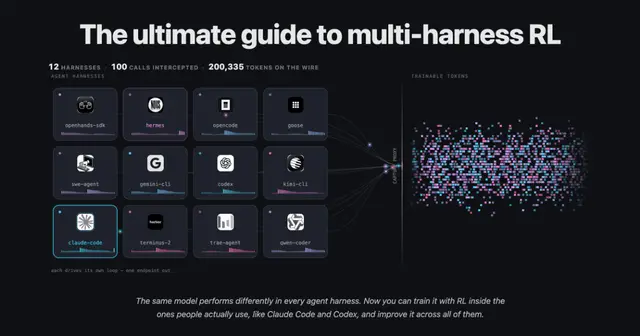
Training models across four agent harnesses with a proxy
A post published on October 2, 2026 describes RL training across four agent harnesses, recording token IDs and sampled logprobs, and reports score improvements.
- AI agentsPaper
Three autonomy levels for agentic recommendations
A survey published on July 7, 2026 proposes a taxonomy of recommendation systems using LLM-based agents, organized by level of autonomy.
- RAG and retrievalPaper
Trie execution plans may speed up retrieval pipeline experiments
An article published on July 2, 2026 presents a radix trie execution plan for PyTerrier that reuses shared prefixes and reports reductions of up to 26% in experiment time.
- Speech: TTS and ASRPost
CPU-based TTS: synthetic speech in 31 languages
A publication dated September 17, 2026, says Supersonic TTS runs on CPU and supports 31 languages. Its author plans to use it to generate synthetic data.
- Speech: TTS and ASRModel
On-device Android TTS with real-time speech
A publication dated August 26, 2026 reports that a 100-million-parameter text-to-speech model runs on Android with LiteRT, offering six voices and real-time or faster playback.
- Attention and model architecturePaper
Tucker Attention frames attention variants through low-rank factorization
Published on September 16, 2026, the paper presents Tucker Attention as a tensor factorization approach that frames MHA, GQA, and MLA as specialized low-rank approximate attention methods.
- Training and fine-tuningPaper
Turn-PPO and training agents across multiple turns
An article published on June 21, 2026 presents Turn-PPO, a per-turn advantage estimation method for using PPO to reinforce-train agentic LLMs, and examines GRPO limitations in long-horizon tasks.
- Attention and model architectureArticle
TWT reduces compute for Vision Transformers
Published on September 26, 2026, the post describes Transformer-Within-Transformer, which replaces groups of similar layers. For DINOv2, it reports about half the compute with a small drop in accuracy.
- Attention and model architecturePaper
Universal Transformers reuse one layer recurrently
A post dated September 17, 2026 describes an architecture that repeatedly applies the same Transformer layer instead of stacking distinct layers, and discusses sequential and parallel computation in sequence models.
- C and C++Article
CPU utilization alone can mislead
Brendan Gregg’s article, published on June 27, 2026, discusses the limits of CPU utilization as a metric for evaluating system performance.
- SecurityPost
uv can block malicious packages before installation
A note dated July 17, 2026, says setting UV_MALWARE_CHECK=1 makes uv query OSV before installing packages from remote registries and block those reported as malware.
- AI agentsArticle
Verification for long-running agents
A post published on August 8, 2026 says the Argus runtime conditions pivots on verification and reports 78% on SWE-Bench Pro, compared with 59% for Direct Copilot.
- AI agentsPaper
VeriHarness verifies agents on long-horizon tasks
A paper published on October 4, 2026 presents a method for checking agent claims against workspace evidence, without reference answers or evaluation rubrics during testing.
- Training and fine-tuningPaper
Vocabulary Transfer for improved sparse retrieval
A paper dated July 2, 2026, attributes advanced encoders’ weaker learned sparse retrieval performance to tokenizer vocabulary incompatibilities and proposes Vocabulary Transfer.
- Speech: TTS and ASRPost
Voice of Reason: reasoning over spoken math
In a September 21, 2026 post, Kyutai Labs says its model solves spoken math problems without an intermediate transcript and scores 77.1% on GSM8K.
- Speech: TTS and ASRProject
VoiceGate brings multilingual dubbing workflows to ComfyUI
Published on June 19, 2026, the project combines transcription, translation, speech synthesis, and timing alignment to dub videos in multiple languages.
- Speech: TTS and ASRDemo
Real-time voice: open-source demo with WebSocket and WebRTC
Published on July 2, 2026, an open-source demonstration combines models and code for real-time voice, with support for WebSocket and WebRTC.
- SecurityArticle
VulHunt: detecting vulnerabilities in binaries
In posts published on June 29, 2026, Binarly’s research team presents the VulHunt framework and an example detecting remote code execution in rsync.
- CUDA and GPU programmingDocs
Vulkan: compute shaders, GPUs and memory models
A tutorial published on July 12, 2026 presents compute shaders, GPU architecture and memory models, concepts that also help explain DirectX 12.
- C and C++Project
Vx demonstrates MLIR lowering for counting leading zeros
In a September 29, 2026 post, Vx shows how the `mlir!` macro maps `math.ctlz` directly to hardware-specific instructions on x86 and ARM.
- Reinforcement learningPaper
WANDR: an environment for evaluating agentic search
In a post published on July 14, 2026, Perplexity says it is making available a reinforcement-learning and evaluation environment for agentic search, synthesized from production traces with weak human supervision.
- RAG and retrievalProject
WeKnora: a knowledge framework with LLMs to evaluate on your own infrastructure
In a post published on September 14, 2026, Tencent describes WeKnora, an open-source framework for document understanding, semantic retrieval, and autonomous reasoning, with source-based answers and self-hosting options.
- AI agentsPaper
WikiSkill: persistent knowledge for agent skills
Published on August 28, 2026, the WikiSkill description separates execution traces, a persistent knowledge wiki, and executable skills to reuse experience across iterations.
- HardwarePost
Xring O3: report cites 15,221 Geekbench 6 points
Published on August 24, 2026, the report attributes scores of 3,945 single-core and 15,221 multi-core to Xiaomi’s Xring O3, with the latter exceeding the Apple M4 result.
- CUDA and GPU programmingArticle
Xtrace proposes detailed tracing of GPU kernels
A description published on September 27, 2026 presents Xtrace, an intra-kernel tracing approach that inserts probes through binary-level instruction splicing.
- C and C++Project
YaFF proposes zero-copy serialization for Protobuf
On June 26, 2026, Yandex described YaFF, a C++ library with a zero-copy wire format for the Protobuf ecosystem. Its repository can inform serialization evaluations.
- Speech: TTS and ASRModel
Youdao evaluates real-time streaming ASR and translation
On September 23, 2026, a Youdao article evaluated two models for real-time speech recognition and translation, reporting streaming support and the ability to chain them.
- LLM inferenceProject
Zlaya: Laya inference on CPU with Zig
Published on September 23, 2026, the GitHub repository presents Zlaya, a compact CPU inference engine for Laya, implemented in Zig.
 arxiv.org







 hgpu.org
Let's assess your project

I reply with scope and a proposal.