


AI and infrastructure news
Filter by type: Article33
- 18 days ago amazon.com
How to structure a CUDA programming learning path
In a publication dated November 9, 2025, an author recommends studying C/C++ and linear algebra before CUDA and suggests books and a course for getting started with GPU programming.
GPU computing: from architecture to optimization
An introductory article published on March 28, 2026, presents GPU architecture and computing as context for engineers developing or optimizing software for this hardware.
- 18 days ago
 hgpu.org
CuBridge explores LLMs for reconstructing CUDA attention kernels
Published on May 10, 2026, the text presents CuBridge, a framework that uses LLMs to understand and reconstruct efficient attention kernels in CUDA.
- 18 days ago manning.com
CUDA for LLMs: kernels, attention and profiling
Published on February 3, 2026, Manning’s book introduces CUDA programming for NVIDIA GPUs, from basic kernels to Flash Attention, and covers profiling with Nsight Compute.
- 18 days ago blog.siggraph.org
From SIMD to SIMT: what GPU evolution means in practice
In an article published on February 5, 2026, ACM SIGGRAPH Blog explains how GPUs combined thread abstractions with SIMD hardware, becoming flexible processors for graphics, AI, and scientific computing.
Tile scheduling in CuTeDSL and persistent kernels
A post published on May 15, 2026, presents StaticPersistentTileScheduler in CuTeDSL and its usefulness for organizing persistent kernels.
Linux GPU module flaws raise local security risks
On November 8, 2025, Quarkslab described two bugs in Linux kernel GPU modules, exploitable by a local unprivileged process.
Blackwell GPU: what its architecture means for your workloads
An article published on March 3, 2026 examines the Blackwell GPU and relates it to NVIDIA’s tradition of building large GPUs. The topic can help teams assess hardware requirements for their workloads.
- 18 days ago turingpost.com
Inference hardware in 2026: cost per token and trade-offs
In an article published on February 28, 2026, Turing Post compares inference chips, including GPUs, a programmable LLM accelerator, and an approach that turns models into hardware, focusing on cost per token.
- 18 days ago hgpu.org
HPC++ automates C++ parallelization for CPUs and GPUs
Published on February 22, 2026, the post describes an LLVM-based framework that converts sequential C++ programs into parallel implementations for multicore CPUs and OpenCL-compatible GPUs.
- 18 days ago tunbury.org
ONNX inference: comparing CPU and GPU
Published on March 11, 2026, the article compares ONNX Runtime inference on an NVIDIA L4 GPU and an AMD EPYC 9965 CPU. The author reports that OCaml and memory placement with libnuma made CPU inference faster than using scarce GPUs at TESSERA.
- 18 days ago tensara.org
CUDA array-sum kernels: from example to practice
Published on November 16, 2025, Tensara’s article introduces beginners to writing a simple CUDA kernel for adding arrays. The example can be a starting point for evaluating GPU workloads.
- 18 days ago paulwillchan.com
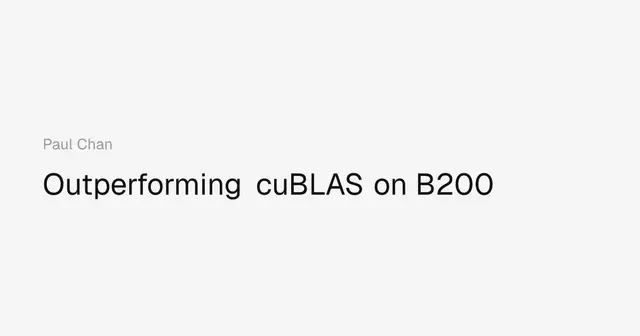
CUDA/PTX matmul kernel reports 6% gain on B200
A post published on April 27, 2026 describes a pure CUDA/PTX matrix multiplication kernel that reportedly outperformed cuBLAS by 6% on a B200 with M=N=K=8192.
GPU kernel optimization beyond SASS latency tables
A post published on November 25, 2025 questions the value of SASS latency tables extracted with nvdisasm and cites 3–4% gains from instruction reordering, against a theoretical limit of 10%.
- 18 days ago siboehm.com
Iteratively optimizing CUDA matrix multiplication
In an article published on February 26, 2026, Simon Boehm describes optimizing a CUDA kernel to approach cuBLAS performance, not to replace it.
- 18 days ago hgpu.org
Agentic RL for generating high-performance CUDA kernels
A March 4, 2026 post presents CUDA Agent, a large-scale agentic reinforcement learning system for generating CUDA kernels, a task that requires specialized hardware knowledge.
- 18 days ago khronos.org
Vulkan 1.1 subgroups: parallelism on the GPU
In a tutorial published on March 4, 2026, Khronos explains how Vulkan 1.1 subgroups let parallel GPU tasks share and manipulate data.
- 18 days ago hgpu.org
FP4 training of MoE models on Hopper GPUs
Published on March 8, 2026, the page discusses FP4 training for large-scale MoE models on Hopper GPUs and identifies activation memory and communication among experts as bottlenecks.
- 18 days ago hgpu.org
VOLT: designing an open-source GPU compiler
Published on February 8, 2026, the article presents VOLT, an open-source GPU compiler, and discusses emerging open GPU architectures with SIMT features.
- 18 days ago rastergrid.com
Vulkan: memory barriers and image layouts
In a post published on March 3, 2026, RasterGrid explains memory barriers and image layouts in Vulkan, topics relevant to GPU memory synchronization.
- 18 days ago aleksagordic.com
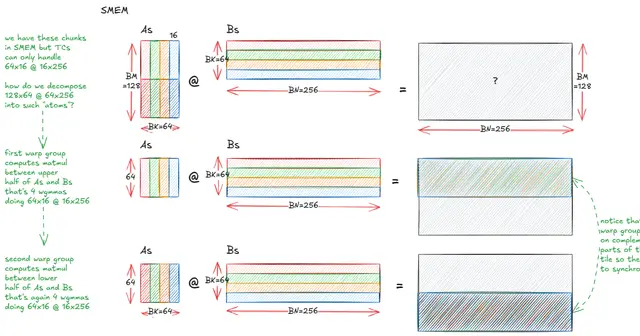
Matrix multiplication kernels on NVIDIA GPUs
An article published on October 1, 2025, on GPU architecture and kernel techniques for accelerating matrix multiplication.
- 18 days ago modal.com
Attention optimization: lessons from FlashAttention-4
In a post published on September 26, 2025, Modal describes reverse-engineering techniques for FlashAttention-4 and attributes a 20% performance gain to them.
Penny and GPU communication: what to monitor
A post dated September 21, 2025, begins a development diary about Penny, a GPU communication library built manually.
- 19 days ago tcgen05.mma
Blackwell Tensor Memory and matmul accumulation
The post describes how Blackwell's Tensor Memory, a separate 256 KB space per SM, stores Tensor Core results and reduces, according to the author, the issue of a matmul from 128 threads to one.
- 19 days ago blog.mlc.ai
How to evaluate agent-driven GPU kernel optimization
TIRx Harness combines compiler analysis, a kernel catalog, hardware specifications and remote GPU evaluation to explore, debug and optimize kernels with agents.
How a memory read moves through the RTX 4090
An article dated August 13, 2026 traces an LDG.E SASS instruction through the RTX 4090’s hardware units and memory hierarchy, including details explored through reverse engineering.
- 19 days ago fergusfinn.com
From nvcc to warps: how a CUDA kernel runs
Published on July 8, 2026, the article follows a vector-addition kernel from compilation with nvcc to execution by GPU warps.
- 19 days ago wheels.astral.sh
GPU indexes expand PyTorch and Python support
An Astral post published on October 5, 2026, reports support for PyTorch 2.13 and 2.14 and Python 3.15, with GPU wheels for packages including FlashAttention and DeepSpeed.
- 19 days ago mlc.ai
CMU book covers GPU programming for ML systems
Published on June 23, 2026, the online book draws on a CMU ML Systems course mini-series and covers GPU programming techniques for ML systems.
- 19 days ago vxlang.org
Heterogeneous memory: compiler capacity checks
In a post published on September 28, 2026, Vx describes a machine model based on capacity, connections, and visibility, and reports two capacity errors found on a laptop without a GPU.
- 19 days ago leetgpu.com
CUDA practice with GPU challenges
In a post published on August 12, 2026, LeetGPU recommends a challenge-based CUDA practice path, from SIMD kernels to shared memory, tiling, and more advanced features.
- 19 days ago leimao.github.io
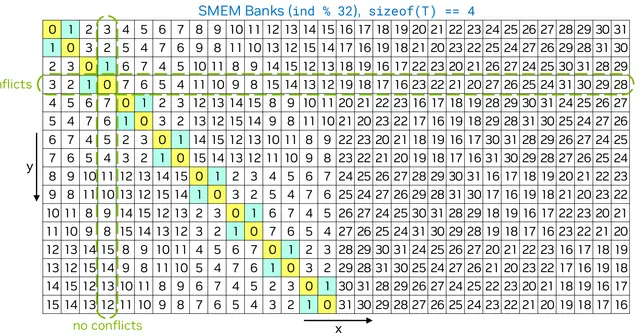
Swizzling to reduce conflicts in CUDA shared memory
A technical article dated August 13, 2026 discusses using swizzling to address bank conflicts in CUDA shared memory, which can affect kernel performance.
- 19 days ago hgpu.org
Xtrace proposes detailed tracing of GPU kernels
A description published on September 27, 2026 presents Xtrace, an intra-kernel tracing approach that inserts probes through binary-level instruction splicing.










Let's assess your project

I reply with scope and a proposal.