


AI and infrastructure news
Filter by type: All68
Author argues short-lived bearer tokens need proof of possession
The post argues that OIDC bearer tokens with 15-minute expiry do not prevent intrusions, and that proof of possession, such as TLS binding, is the only real solution. The author also predicts OIDC will end soon.
Private CA roots can issue certificates without transparency log entries
The post claims that TLS inspection roots installed on corporate laptops can issue certificates for any domain without appearing in certificate transparency logs, a trust gap that calls for local monitoring.
- 17 days ago github.com
Collection on Linux kernel security and exploitation updated with January and February entries
The collection on Linux kernel exploitation was updated with January and February links on kernel security. For infrastructure teams, it points to the need to track this topic in a systematic way.
Prompt injection vectors: how to test and harden AI systems
The post gathers prompt injection vectors and strategies with examples, useful for assessing and hardening the security of applications built on language models.
- 17 days ago microsoft.com
Collaborative applications with verifiable operations
Microsoft Research's project explores an architecture for collaborative applications with encrypted data and cryptographically verifiable operations.
- 17 days ago youtube.com
Ultrasonic blockers: privacy limitations
Published on March 3, 2026, the article questions claims about a portable audio blocker and identifies factors that may limit device detection and range.
Bootloaders: assessing risks and defenses
An article published on June 5, 2026, covers attack surfaces, vulnerability detection, and defenses in firmware, operating systems, and monolithic bootloaders.
- 17 days ago github.com
CAI: an AI framework for security operations
Published on June 7, 2026, the material presents CAI, an open-source framework for cybersecurity operations with multi-agent workflows, CTF automation, and vulnerability research.
GPS field of 176 bits may expose operational metadata
A June 4, 2026 publication reports high-entropy payloads in a public GPS navigation field, but does not prove it is an encrypted control or key-distribution channel.
- 17 days ago huggingface.co
How to evaluate language models for vulnerability analysis
Published on February 9, 2026, the repository presents a reasoning model that searches code for vulnerabilities by analyzing data and control flows.
- 17 days ago sbytec.com
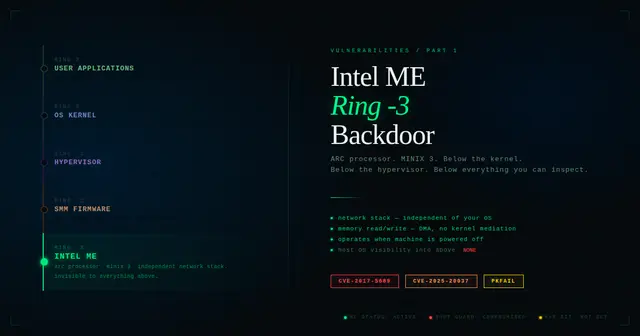
Structuring Intel Management Engine risk detection
Published on February 24, 2026, the article examines Intel Management Engine architecture and firmware, related vulnerabilities, and detection methods.
- 17 days ago github.com
CVE-Genie and automated exploits for known vulnerabilities
The repository description, published on June 15, 2026, presents CVE-Genie as a tool that generates working exploits from known vulnerabilities through a few API calls.
- 17 days ago gitlab.com
cvs-fast-export 2.1 fixes errors with binary blobs
Published on June 10, 2026, cvs-fast-export 2.1 fixes an “invalid delta” error when processing binary blobs in RCS or CVS histories.
- 17 days ago surfshark.com
Dausos: Surfshark presents a new VPN protocol
On June 15, 2026, Surfshark presented Dausos, a VPN protocol it describes as designed for speed, security, and efficiency, using AEGIS-256X2.
- 17 days ago cs.auckland.ac.nz
Secure deletion depends on the storage medium
Peter Gutmann’s 1996 article discusses data remanence and the limits of overwriting magnetic and solid-state storage, underscoring why sanitization methods should account for the medium.
- 17 days ago github.com
C2 feeds can enrich corporate security defenses
Published on May 11, 2026, the C2IntelFeeds repository gathers indicators of suspicious and verified infrastructure generated through large-scale internet scans.
- 17 days ago icode4.coffee
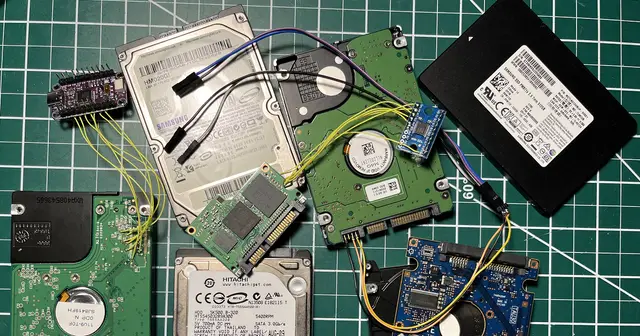
HDD and SSD firmware: analysis and operational security
Published on May 27, 2026, the post describes a series covering HDD and SSD firmware dumps, reverse engineering, modification, and JTAG debugging.
- 17 days ago microsoft.com
Using AI to identify gaps in threat detection
In an article published on January 31, 2026, Microsoft describes an AI workflow that extracts TTPs from reports, compares them with existing detections, and flags potential gaps for human review.
- 17 days ago sysdig.com
AWS intrusion: exposed credentials lead from S3 to Bedrock
In an article published on February 4, 2026, Sysdig describes an AWS intrusion that began with credentials exposed in S3, moved through Lambda, and reached Bedrock access. The article highlights an Elastic rule for detecting external layers added to Lambda functions.
- 17 days ago ieeexplore.ieee.org
Gradient inversion in Federated Learning: risks and defenses
Published on January 16, 2026, the post presents a study of gradient inversion attacks in Federated Learning. It says the most practical attack method remains unreliable and that the work proposes a three-stage defense.
- 17 days ago github.com
Leaker and passive enumeration of exposed credentials
Published on January 12, 2026, the repository describes a tool for finding credential leaks associated with email addresses through passive online sources.
- 17 days ago github.com
MogVMP converts VMProtect 3.0–3.5 code to LLVM
Published on May 31, 2026, the MogVMP repository describes static devirtualization of code protected by VMProtect 3.0–3.5.
- 17 days ago github.com
Keyword monitoring on .onion sites
On February 26, 2026, the publication described a repository for scanning keywords on .onion sites, with a stated focus on threat intelligence and brand monitoring.
NIST argues for continuous monitoring in AI security
In an article published on June 12, 2026, NIST presents a mathematical proof supporting an AI security model based on continuous monitoring and updates, as an alternative to static controls.
- 17 days ago github.com
OpenVul proposes an LLM framework for vulnerability detection
Published on March 5, 2026, the OpenVul repository describes an open-source post-training framework for language models aimed at vulnerability detection.
- 17 days ago github.com
Research on LLMs for vulnerability detection
A GitHub collection gathers research on using language models to detect software vulnerabilities in functions and repositories, including agent-based approaches. Published on June 14, 2026.
Post warns of AI-orchestrated intrusion attempts
Published on June 3, 2026, the post says AI agents connected to scanners, shells, and other tools could make intrusion workflows more repeatable and less costly.
- 17 days ago infinitetoolsoft-cyber.github.io
Post raises risks in judicial-data extraction and automation
Published on May 17, 2026, the post alleges that a tool extracts court cases, enriches data with information from Serasa, and sends WhatsApp messages. It also mentions HWID-based licensing and communication with a central server every 30 seconds.
Praetorian uses AI agents to generate Nuclei templates for CVE detection
Praetorian describes a multi-agent pipeline that turns CVE research into validated Nuclei detection templates, using specialized agents and an actor-critic refinement loop.
- 17 days ago github.com
Cybersecurity resources: posts, papers and tools
A GitHub list gathers blog posts, writeups, papers and cybersecurity tools as a starting point for engineers.
- 17 days ago zeltser.com
REMnux connects AI agents to over 200 malware analysis tools
Published on February 9, 2026, the article describes an MCP server connecting AI agents to REMnux tools and providing guidance on tool selection and result interpretation.
- 17 days ago eprint.iacr.org
SHA-2 collision attacks reach 39 steps
An article published on June 2, 2026 reports an improved search procedure for SHA-2 collisions and places the advance against earlier results of up to 37 steps.
- 17 days ago tugraz.elsevierpure.com
Browser SSD side channel may reveal user activity
An article published on May 29, 2026 reports that SSD latency measurements through the browser's Origin Private File System can identify visited sites and detect launched desktop applications.
Research worm adapts attacks to vulnerability classes
A publication dated June 3, 2026 describes a research worm that adapts its attack logic and replicates across Linux, Windows, and IoT systems in a corporate-network test.
- 17 days ago github.com
Public exploit index supports CVE security testing
Published on October 6, 2025, the repository indexes public proof-of-concept exploits linked to CVEs across five sources, supporting vulnerability research and security testing.
- 17 days ago github.com
Anthropic repository outlines a security analysis and remediation workflow
Published on July 12, 2026, the repository includes skills for threat modeling, scanning, triage, and patching, plus a customizable harness for autonomous scanning.
- 17 days ago github.com
Reverse engineering roadmap guides malware analysis
Published on June 25, 2026, the GitHub repository organizes reverse engineering and malware analysis topics and tools, including x86/x64 assembly, static and dynamic analysis, and anti-RE techniques.
- 17 days ago github.com
How to assess tools that bypass network inspection
A publication dated August 30, 2024, cites three open-source tools for bypassing deep packet inspection and points to a practical use: assessing network filtering controls.
- 17 days ago github.com
DocEx tests defenses against document exfiltration
Published on April 20, 2025, the text describes DocEx, an APT emulation tool that simulates the exfiltration of DOCX, PPTX, XLSX, and PDF files to assess security defenses.
- 17 days ago hackmosphere.fr
Defender evasion: assessing and improving detections
Published on April 19, 2025, the article describes a two-part series on Windows Defender evasion, including direct syscalls and XOR. Part one provides basic experimental code and points to defensive uses in evaluating antivirus defenses and improving detections.













Let's assess your project

I reply with scope and a proposal.