


AI and infrastructure news
- Reinforcement learningPost
Training terminal agents in Dockerized RL environments
A post published on June 24, 2026 describes 14,600 Dockerized reinforcement-learning environments and an outcome-only DPPO recipe. A 9B model reached 27% on Terminal-Bench 2.0.
- Attention and model architectureArticle
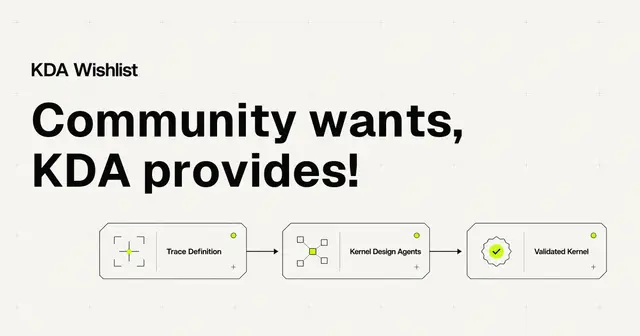
Agents optimize GPU attention kernels
A September 28, 2026 NVIDIA post reports attention kernels up to 2.96 times faster than FlashKDA on B300, with one tenth the state error.
- AI agentsArticle
Agents for reproducing research and provisioning GPUs
OpenResearch is described as a tool that uses agents to reproduce paper results and provision cloud GPUs. The author says it reproduced their paper end to end.
- AI agentsPaper
Agents can decide when to seek more context
An article published on August 22, 2026 models interactive agents’ choice between acting on assumptions and seeking context, accounting for the costs of those actions.
- AI agentsPost
Agents that update their model of the environment during inference
A post published on June 30, 2026, about ARC-AGI-3 says that learning during inference leads agents to build models of rules and mechanics, updating them with new evidence.
- Attention and model architectureArticle
Algorithms in transformer weights: practical applications
Published on June 24, 2026, the article about The Transformer Cookbook describes encoding addition, search, and branching algorithms in transformer weights, following work on RASP.
- Reinforcement learningProject
RL environments and training code for language models
On September 26, 2026, Xiaomi MiMo published reinforcement learning environments, training code, and a dataset for experiments with language models.
- Reinforcement learningProject
SQL-based replay buffer sampling
A post published on August 16, 2026 describes weighted top-k sampling in SQL and reports selecting 8,192 rows from 50 million in about 1.1 seconds on a laptop.
- SecurityArticle
Black-box analysis of Xiaomi’s MJA1 secure chip
On June 28, 2026, Quarkslab described an analysis of the MJA1 chip covering hardware, I2C traffic, flash extraction and firmware. The work mapped the command protocol and assessed security properties.
- Training and fine-tuningPaper
Continuous learning: evaluating models updated after deployment
A publication dated September 29, 2026 describes a 7B model updated with prediction-market data and evaluated in continuous backtests over 390 days.
- Attention and model architectureProject
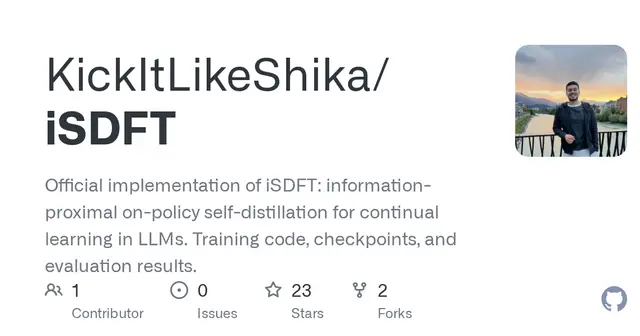
Continual learning in LLMs with iSDFT
A repository published on September 22, 2026 presents a self-distillation method for continual learning in LLMs, with training code, checkpoints, and evaluations.
- Attention and model architectureProject
Continuous learning on a notebook with 8 GB of VRAM
The mini-AGI repository describes a model trained from scratch on a notebook with 8 GB of VRAM, using batch size 1, disk-paged weights, and learning-rate adjustments to reduce forgetting.
- AI agentsPaper
AREAL2.0 links real tasks to agent improvement
Published on July 10, 2026, the article presents a continuous-learning architecture that turns real tasks into training data and triggers policy updates.
- Training and fine-tuningPost
ARGUS diagnoses slowdowns in large-scale training
A paper published on arXiv on June 19, 2026 describes a system combining CPU, framework, and GPU data to investigate training slowdowns, with continuous overhead below 2%.
- C and C++Article
Building floating-point arithmetic from scratch
Published on July 6, 2026, the article explores building floating-point arithmetic from scratch as an advanced technical project for engineers.
- Attention and model architecturePost
Hybrid architectures beyond standard attention
A post published on July 8, 2026, compares the architectures of Qwen 3.5 and Nemotron 3 and describes linear attention and state-space models as examples of convergent evolution.
- C and C++Article
Multidimensional arrays: how access patterns affect performance
In an article published on July 11, 2026, Eli Bendersky compares the performance of different access patterns for multidimensional arrays using benchmarks.
- SecurityPaper
Practical attacks on privacy and availability in 4G/LTE networks
A 2015 article examines practical attacks affecting privacy and availability in 4G/LTE mobile communication systems.
- Attention and model architecturePaper
Attention in long-context Transformers
Published on September 15, 2026, the paper analyzes attention rank collapse as context grows and studies rescaling scores by a polylogarithmic factor.
- Attention and model architecturePaper
Natively trainable sparse attention for long contexts
An article published on September 26, 2026, presents NSA, a sparse attention approach combining algorithmic innovations and hardware-aligned optimizations for more efficient long-context modeling.
- Attention and model architecturePost
Sparse attention can optimize KV block selection
A Tencent publication dated September 14, 2026 describes a method that uses language modeling loss to learn which KV blocks each query should access.
- Attention and model architecturePost
Dynamic linear attention adapts memory to token information
A post published on June 15, 2026, describes Dynamic Linear Attention adapting memory states to token information while keeping a fixed cache, and reports gains in benchmarks, throughput, and memory use.
- Attention and model architecturePost
Linear and sparse attention: evaluating long-context models
A post dated August 26, 2026, claims GLM-5.3 uses three linear-attention layers for each sparse-attention layer, highlighting compute-efficiency trade-offs for long contexts.
- Attention and model architectureArticle
On-Demand Attention aims to balance long context and speed
A publication dated September 20, 2026 describes On-Demand Attention, which uses a lightweight head to trigger full context when needed, aiming to speed decoding while recovering much of the performance lost with local attention.
- Attention and model architecturePaper
Attention sinks and rescaling in transformers
Published on October 5, 2026, the paper examines attention sinks and residual sinks in large language models and proposes how these outliers, softmax attention, and RMSNorm rescale other components.
- CUDA and GPU programmingPaper
NVIDIA CUDA guide update calls for a technical review
NVIDIA's publication says the CUDA C++ Programming Guide was updated in June 2026. Companies developing GPU software can review their practices and document the standards used across projects.
- AI agentsPaper
Self-improvement in agents: making adaptation controllable
A survey published on July 16, 2026 examines modern agentic systems as foundation models integrated with prompts, memory, and tools. Its system-level view helps identify where updates happen and how to make them controllable.
- AI agentsPost
Autodata structures agents to create and evaluate datasets
Published on June 25, 2026, the material presents Autodata, a staged method in which AI agents create and analyze training and evaluation data, then apply meta-optimization.
- AI agentsPaper
Autodata generates training data with agent loops
Published on July 6, 2026, the Autodata method uses weak and strong solvers to select questions that distinguish model performance.
- Reinforcement learningPost
AutoDecompiler applies RL to iterative decompilation
A post dated June 25, 2026 describes a model using reinforcement learning and direct feedback across multiple stages of decompilation.
- AI agentsPaper
Automating scientific review while keeping human oversight
The article, published on June 29, 2026, frames scientific review at scale as a systems challenge and proposes four levels of collaboration between AI and humans.
- AI agentsPost
AutoMem explores agent-managed memory
A post published on July 6, 2026 describes a paper on agents that write, search, and organize notes, with reported 2x to 4x gains in long games.
- AI agentsPost
Autoresearch agent beats a manual harness after eight days
A post published on July 14, 2026, reports that an autoresearch agent improved over eight days and outperformed a manually tuned harness on benchmarks excluded from training.
- AI agentsArticle
AutoResearch automates reinforcement learning experiments
A post published on June 18, 2026 describes an agent that planned and ran GPU-based reinforcement learning experiments, including code writing, debugging, and summarizing conclusions.
- SecurityPaper
Secure backups for high-value secret keys
An article published on September 24, 2026, discusses backing up high-value secret keys and identifies their protection as a security concern.
- SecurityArticle
Benchmark compares models for vulnerability discovery
Published on July 18, 2026, the DeepSec benchmark compares model recall, precision, and cost in an open-core application for security analysis.
- AI agentsArticle
Benchmark compares seven self-hosted memory providers for Hermes Agent
Published on August 9, 2026, the community benchmark compares seven self-hosted memory providers for Hermes Agent, using 71,060 conversation turns and 3,750 questions about changing facts.
- Attention and model architectureArticle
BF16 in FlashAttention: monitor gradient stability
On September 29, 2026, a technical work reported that BF16 rounding in FlashAttention can break a softmax gradient symmetry and cause explosions near the end of training. The authors propose GProj as a correction.
- AI agentsPaper
BINEVAL makes LLM evaluations more interpretable
Published on June 27, 2026, the post describes a binary-question evaluation that matched or outperformed UniEval and G-Eval on three datasets without training.
- LLM inferencePost
BITCOS reduces storage for ternary LLMs
In a post published on September 20, 2026, Intel describes BITCOS, a method that stores exact ternary LLM weights at 1.485 bits per weight and reports decode throughput gains.
 arxiv.org


Let's assess your project

I reply with scope and a proposal.