


AI and infrastructure news
- CUDA and GPU programmingArticle
Blackwell Tensor Memory and matmul accumulation
The post describes how Blackwell's Tensor Memory, a separate 256 KB space per SM, stores Tensor Core results and reduces, according to the author, the issue of a matmul from 128 threads to one.
- Speech: TTS and ASRProject
Breeze TTS 2 opens model weights
On August 26, 2026, BreezeBlue announced open weights for Breeze TTS 2 and said the model leads a voice evaluation arena.
- Speech: TTS and ASRPost
Breeze TTS 2: Multilingual voice generation in streaming
A publication dated August 25, 2026 describes a speech synthesis model supporting 50 languages, text-prompt voice generation, and streaming output.
- AI agentsArticle
BrowserBC turns human browsing into reusable agent skills
Published on July 7, 2026, the post describes BrowserBC, which turns human browsing traces into reusable skill cards. It reports gains in task success, retrieval, and generalization across sites.
- RAG and retrievalPaper
Local-first search: retrieval for sensitive data
A paper published on June 30, 2026 proposes a framework for privacy-focused information retrieval, with indexes, models, and inference on users’ devices.
- AI agentsPost
Local hybrid search for agents: what zg offers
On September 2, 2026, Alibaba's Zvec team announced zg, a local search tool combining semantic search, BM25, hybrid search, and rg, with support for popular agents.
- AI agentsProject
Buzz publishes a specification for agent memory
On July 28, 2026, Buzz published the NIP-AE specification for its memory feature, aiming to support implementation and interoperability.
- C and C++Post
C++26 standardizes Hazard Pointers for concurrent code
Published on June 30, 2026, the post says C++26 standardizes Hazard Pointers to defer node deletion until concurrent readers have finished using them.
- C and C++Paper
C*: Bringing programming and verification closer in C
An article dated September 8, 2026 presents C*, an approach to bring conventional C programming closer to formal verification.
- Attention and model architecturePost
A 64-token cache for linear attention: what to evaluate
A post about HOLA, published on July 5, 2026, describes a parameter-free token-surprise metric and a 64-token cache to address catastrophic forgetting in linear-attention models.
- LLM inferenceVideo
Cache and attention: inference optimization
A post dated October 1, 2026 reports attention techniques and reduced KV cache in a language model, with potential implications for inference costs.
- LLM inferencePaper
Test-time training layers for sequence modeling
A paper published on September 24, 2026 presents sequence-modeling layers with linear complexity and hidden states updated through self-supervised learning.
- Attention and model architecturePaper
Sparse layers and looping for scaling language models
An article published on September 26, 2026 compares standard Transformers and Mixture-of-Experts, with and without looping, and reports a scaling advantage for Looped-MoE models.
- RAG and retrievalPaper
CAMI evaluates RAG indexes under a limited budget
Published on June 30, 2026, the CAMI paper proposes selecting semantic enrichment indexes for ingestion pipelines based on retrieval goals and computational cost.
- SecurityArticle
TPM-protected TLS client keys in Go
An article dated September 7, 2026 explains how to use a client certificate in Go whose private key remains in a TPM, and discusses the per-handshake performance cost.
- Training and fine-tuningArticle
Classifying documents at scale with few examples
A post published on September 10, 2026 describes labeling 200 examples with an agent and classifying 191,724 documents for about US$0.70 in inference compute.
- OCR and document AIProject
Tax-page classifier evaluated on 261 forms
A GitHub repository describes an open-source classifier for tax-document pages and reports 100% strict accuracy on 261 IRS forms, at about US$0.001 per page.
- RAG and retrievalPaper
CMDR evaluates multimodal retrieval across document pages
Published on July 8, 2026, the article presents CMDR and CMDR-Bench for retrieving relevant pages from multimodal documents, including queries that depend on context across pages.
- Speech: TTS and ASRProject
CocktailASR-1 transcribes a selected voice in overlapping audio
Published by Xiaomi on September 16, 2026, CocktailASR-1 uses reference voiceprints to transcribe a chosen speaker in mixed audio. The publication reports support for English and Chinese.
- Reinforcement learningPost
CodeMidas creates RL training tasks from code
In a post dated September 21, 2026, Xiaomi describes CodeMidas, which uses agents to generate 5,545 executable tasks in 23 languages from open-source codebases.
- Reinforcement learningPaper
CodeMidas proposes generating RL tasks from code
On September 21, 2026, CodeMidas presented a pipeline that converts features from open-source projects into executable reinforcement-learning environments for programming.
- AI agentsPost
Iterative code improves scientific forecasts
A study published in Nature assessed combinations of forecasting methods across six fields: 24 of 55 combinations outperformed both methods from which they originated.
- LLM inferenceProject
Colibri streams MoE experts from disk for local inference
A pure-C inference engine loads experts from mixture-of-experts models from disk, offering an approach to evaluate local execution on hardware with limited memory.
- AI agentsPaper
How agents can learn from interaction traces
A survey published on June 27, 2026, discusses how agents in production turn interaction traces into durable capabilities, from self-evolution to meta-evolution.
- Speech: TTS and ASRPaper
Extending frozen LLMs to understand audio
A paper dated September 28, 2026, proposes injecting audio-conditioned vectors into a frozen LLM's KV cache to add audio understanding without tuning model weights.
- C and C++Article
How to analyze malloc behavior in glibc
The glibc wiki covers malloc internals. Published on June 25, 2026, the page addresses how the memory allocator handles allocations.
- AI agentsPaper
How to evaluate AI agent memory
An article published on June 26, 2026 examines agent memory systems and notes that existing evaluations often treat memory as a black box.
- CUDA and GPU programmingArticle
How to evaluate agent-driven GPU kernel optimization
TIRx Harness combines compiler analysis, a kernel catalog, hardware specifications and remote GPU evaluation to explore, debug and optimize kernels with agents.
- Attention and model architecturePaper
Evaluating efficient attention in hybrid models
Published on June 16, 2026, the paper examines sliding-window attention and recurrent sequence mixers in hybrid language models, focusing on scalability, mechanisms, and architecture decisions.
- Attention and model architecturePaper
How to assess autoregressive inference bottlenecks
An ICLR 2026 paper addresses a decoding bottleneck in probabilistic Transformer models. Companies can measure inference performance and identify opportunities for optimization.
- Attention and model architectureArticle
How to assess LLM access to knowledge in its parameters
In a June 28, 2026 publication, the Google Research blog examines how reasoning may help language models access knowledge stored in their parameters. The question can inform internal tests of models and prompts.
- AI agentsPost
Evaluating rewards for coding agents
A July 4, 2026 post describes four reward signals for coding agents and discusses failures and corrections that can help detect reward hacking.
- LLM inferencePost
How to assess KV cache reductions
A post reports an alleged reduction in KV cache use from 389,000 to 890 bytes per token over three years. The claim points to an opportunity to measure memory and cost in long-context systems.
- Reinforcement learningPaper
How to evaluate asynchronous RL for agent post-training
A post published on July 9, 2026 discusses asynchronous RL for language-model post-training, updates as rollouts arrive, and stability techniques.
- AI agentsArticle
How coding agents learn from software development experience
Published on August 9, 2026, the survey analyzes 108 systems that use development interactions to adapt memory, workflows, tools, or model parameters.
- RAG and retrievalPaper
Comparing RAG approaches for semi-structured data
A paper published on June 25, 2026 presents a framework for comparing four RAG approaches across nine standardized scenarios.
- Reinforcement learningArticle
Directing RL compute toward harder problems
An article published on September 18, 2026, reports that the adaptive Never Give Up method samples until success to direct reinforcement-learning training compute toward harder problems in LLMs.
- RAG and retrievalPaper
How to allocate capacity in hierarchical search agents
An article published on July 9, 2026 examines delegation and execution roles in hierarchical search agents and identifies task decomposition as the main performance bottleneck.
- Training and fine-tuningPaper
How reinforcement learning is distributed across LLM layers
A preprint published on July 15, 2026, examines how reinforcement learning adaptation is distributed across transformer layers during LLM post-training.
- Attention and model architectureArticle
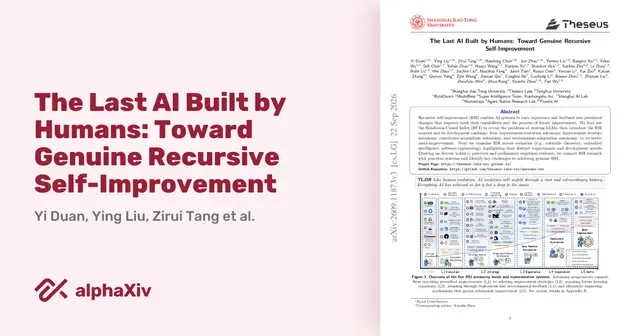
Structuring AI self-improvement cycles
An article published on September 13, 2026 presents a framework for AI systems to identify limitations, validate changes, and retain improvements through persistent cycles.

 arxiv.org



Let's assess your project

I reply with scope and a proposal.