


AI and infrastructure news
- OCR and document AIProject
PaddleOCR 3.7 expands inference options for OCR
In a post published on June 17, 2026, PaddleOCR announced an ONNX Runtime inference backend and CPU inference via OpenVINO, as well as GPU inference via CUDA and TensorRT. The post says PP-OCRv6 models can be up to 3.9 times faster on CPU.
- LLM inferencePaper
PagedAttention and KV cache management in LLM serving
An article published on September 24, 2026 presents PagedAttention, a virtual-memory-inspired approach to reducing KV cache fragmentation and duplication, which can limit batch size.
- AI agentsPost
Pandora’s Router balances estimation and routing costs
A paper published on August 22, 2026 proposes using cheap, noisy estimates before paying for better evaluations. On MATH, RAG, and EmbedLLM, it achieved or tied for the lowest average combined inspection cost and routing regret.
- Training and fine-tuningPaper
Paper reports gains from redistributing capacity across layers
Research on language models reports that cosine-shaped capacity allocation improved perplexity without increasing parameters or FLOPs.
- Reinforcement learningPaper
Paper evaluates LLM-as-a-Judge feedback in training
Published on September 19, 2026, the paper studies using the language model itself to provide feedback during training and compares this approach with frozen reward models trained on human preferences.
- Attention and model architectureArticle
PC-ALM trains residual MLPs up to 1,000 layers deep
Published on September 14, 2026, the paper presents PC-ALM, a local learning method for deep networks with performance described as nearly equivalent to backpropagation.
- SecurityArticle
Research warns of cleartext traffic on GEO satellite links
Research published on June 18, 2026, reports that a significant portion of GEO satellite traffic is transmitted without encryption and could be intercepted using relatively accessible equipment.
- SecurityPost
Reverse-proxy phishing can bypass MFA
A post dated August 9, 2026, describes how phishing kits can relay logins and capture session cookies after multifactor authentication.
- SecurityPost
Device-code phishing is not limited to Wi-Fi
Published on July 25, 2026, the post warns that device-code authentication phishing can also occur over Ethernet or the internet.
- Speech: TTS and ASRPaper
Phoenix-VAD: detecting the end of speech in voice dialogues
An article published on September 4, 2026 presents an LLM-based model for semantic end-of-speech detection in full-duplex streaming voice interactions, using sliding-window training.
- Speech: TTS and ASRPost
Phonon-1: evaluating local audio transcription
A post dated August 28, 2026 presents Phonon-1, a speech recognition model with 782 million parameters, a 415 MB download, and an Apache 2.0 license.
- Speech: TTS and ASRArticle
Photon 2.1 expands streaming ASR for self-hosted deployments
Moondream says Photon 2.1 adds streaming speech recognition for three models and beats each model’s reference engine in all comparable tests.
- Speech: TTS and ASRProject
ComfyUI plugin supports local voice and LoRA tuning
Published on August 25, 2026, the ComfyUI_VoxCPM_SM repository presents VoxCPM2 inference and LoRA fine-tuning with custom voice data, supporting low VRAM and quantized models.
- Training and fine-tuningPost
Model pruning uses effective sample size to select components
A post published on July 1, 2026 presents Effective Model Pruning, a method that uses effective sample size to calculate how many components to retain in neural networks and language models.
- Attention and model architecturePaper
PolaFormer++ proposes polarity-aware features for linear attention
The paper dated September 26, 2026 presents a theoretical criterion for feature-map spikiness and evaluates linear attention across six families of visual tasks.
- Reinforcement learningPost
Policy gradients: from derivation to practical evaluation
Published on August 30, 2026, the article reviews foundational reinforcement learning work, derives the policy gradient algorithm, and discusses its variants.
- Reinforcement learningPaper
Positional encodings: comparing alternatives to RoPE
A study published on September 29, 2026 examines RoPE’s bias toward nearby tokens and alternatives evaluated across different configurations.
- SecurityProject
Post announces bootrom exploit for Apple chips
Published on June 18, 2026, the post says a bootrom exploit was released for A12, A13, S4/S5, and A12X/Z chips, which have not yet been tested.
- Attention and model architecturePost
Post points to efficient designs in frontier Chinese models
Published on August 26, 2026, the post says frontier Chinese models are adopting linear or sparse attention, specialized residual designs, and Muon. It also presents open-source collaboration as a strategy for efficiency.
- Reinforcement learningArticle
Post compares OPD and RL efficiency in model training
Dated June 19, 2026, the post claims OPD can use compute and samples more efficiently than RL in finding high-reward reasoning traces.
- LLM inferencePost
Post describes calibration-guided low-bit compression of Hy4
A post published on August 29, 2026, says Tencent reduced the Hy4 preview from 1.5 TB to 200 GB by setting precision per layer. It reports results on two benchmarks.
- SecurityArticle
Post reports decryption of protected iOS IPA without a physical iPhone
Published on September 27, 2026, the post claims that FairPlay-protected iOS IPAs can be decrypted without a physical iPhone or jailbreak. The report is relevant to app protection assessments.
- Training and fine-tuningPaper
Post-training and real-world model adaptation
Slides from an introductory lecture, published August 21, 2026, present post-training methods and adaptation questions for agents in changing environments.
- Training and fine-tuningArticle
PostTrainBench highlights model performance and reliability
On June 25, 2026, a post about PostTrainBench reported close ranking scores and zero failed runs in 84 attempts for GLM 5.2.
- Training and fine-tuningPaper
PPO and GRPO: choices for long-horizon training
A post published on June 21, 2026 discusses GRPO’s infrastructure constraints and the declining effect of group-based variance reduction on long sequences, compared with PPO.
- CUDA and GPU programmingArticle
CUDA practice with GPU challenges
In a post published on August 12, 2026, LeetGPU recommends a challenge-based CUDA practice path, from SIMD kernels to shared memory, tiling, and more advanced features.
- LLM inferenceArticle
dstack Presets proposes portable inference optimization
Published on August 20, 2026, dstack’s announcement presents an open-source toolkit that uses agents to simplify inference optimization and store results in a portable format.
- C and C++Article
PRISM and binary translation on Windows on Arm
Published on September 10, 2026, the article examines PRISM, the binary translation system used by Windows on Arm, and its effects on code execution.
- Attention and model architecturePaper
Executable programs for studying Transformer attention heads
A paper published on June 29, 2026 proposes approximating deep-network components with executable programs, applying the method to attention heads in Transformer language models.
- Attention and model architecturePost
Synthesized programs could replace some attention heads
A post published July 1, 2026 describes Python programs synthesized from attention maps, reporting 69–79% mean IoU and little QA decline when replacing up to 30–40% of heads.
- Training and fine-tuningArticle
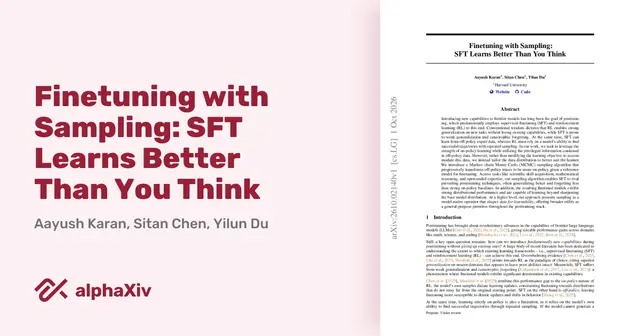
Projection Sampling adapts demonstrations for SFT
A paper published on October 4, 2026 presents a way to rewrite expert demonstrations as correct task trajectories that are more likely under the target model, then use them in standard supervised fine-tuning.
- Reinforcement learningPost
ProRL Agent separates rollouts from LLM policy training
Published on September 30, 2026, ProRL Agent describes open-source rollout infrastructure that separates trajectory generation, environment orchestration, and evaluation from policy optimization for multi-turn agents.
- Training and fine-tuningPaper
Pruning or training small LLMs from scratch?
The paper compares six pruning methods for Llama-3.1-8B with training from scratch under two token-budget scenarios; the advantage depends on how the budget is counted.
- Attention and model architecturePaper
PTXBench measures performance of AI-generated GPU kernels
Published on September 29, 2026, PTXBench evaluates matrix multiplication and attention kernels in architecture-specific PTX on H100 and B200 GPUs, measuring correctness, speed, and whether requested instructions are actually executed.
- CUDA and GPU programmingPost
PufferLib 4.0 reports multi-GPU scaling
Published on June 21, 2026, the report on PufferLib 4.0 describes 6.6× scaling across eight GPUs in a worst-case test and throughput above 100 million steps per second on eight RTX 5090 GPUs.
- Training and fine-tuningPaper
QLoRA: fine-tuning a 65-billion-parameter model on a 48 GB GPU
A paper dated September 20, 2026, reports fine-tuning a 65-billion-parameter model on a single 48 GB GPU with QLoRA, preserving performance on 16-bit fine-tuning tasks.
- SecurityArticle
QuadRF tracks drones and detects Wi-Fi with a phased-array radio
In a post published on July 10, 2026, Jeff Geerling describes QuadRF, a radio built with a Raspberry Pi 5 and an FPGA board that uses signal processing and beamforming to track drones and detect Wi-Fi through walls.
- C and C++Project
Qualcomm opens FastRPC compiler for Hexagon
On September 18, 2026, Qualcomm announced the release of the IDL FastRPC compiler source code for Hexagon and pointed to the QAIC repository.
- LLM inferencePost
Unsloth reports 1-bit quantization reducing model to 217 GB
In a post published on August 28, 2026, Unsloth reports dynamically quantizing GLM-5.3 to 1 bit: 217 GB versus 1.5 TB in BF16, with about 76% top-1 accuracy.
- LLM inferenceModel
Quantization reduces Hy4 Preview to 214 GB
A Tencent post dated September 1, 2026, says Sherry quantization takes Hy4 Preview from 1.5 TB to 214 GB and describes running it on GPUs distributed across multiple machines.

 arxiv.org



Let's assess your project

I reply with scope and a proposal.