


AI and infrastructure news
- AI agentsPaper
JAZ explores agents built around one code primitive
Published on September 26, 2026, the post describes the JAZ framework and reports results on StuLife and AppWorld, with lower costs than the compared approaches.
- Training and fine-tuningPaper
JEPA-Anything explores predictive learning across seven domains
The post, published on October 6, 2026, presents JEPA-Anything as a domain-agnostic world-modeling framework based on orthogonal predictive factorization.
- LLM inferencePaper
JetSpec speeds up speculative decoding with parallel draft trees
A post published on July 7, 2026 describes JetSpec, which uses a single forward pass to generate coherent draft trees and reports speedups of up to 9.64× on MATH-500 and 4.58× in open-ended conversations.
- AI agentsPaper
JIT-Agent adapts agent harnesses to each task
The article on JIT-Agent describes on-demand synthesis and evolution of harnesses for LLM-based agents, using modules for memory, planning, actions, and tools. Published August 27, 2026.
- Attention and model architecturePaper
KATA explores spherical packing for recall in linear attention
A paper published on September 16, 2026 presents KATA, a geometric approach that formulates associative recall in linear attention as a spherical packing problem.
- RAG and retrievalPaper
KbSD proposes calibrating search decisions in agents
Published on June 30, 2026, the paper describes a self-distillation method to guide search agents in choosing between model memory, retrieved evidence, or abstention.
- Attention and model architectureArticle
Triton paged-attention kernel for technical evaluation
A July 10, 2026 post shares a Triton paged-attention kernel attributed to an AI model and a solution file hosted on KernelBench.
- Attention and model architecturePaper
KITE expands Transformers without increasing KV computation
Published on September 29, 2026, the material describes KITE, an approach that expands decoder components by reusing a KV cache generated by a smaller prefiller.
- Training and fine-tuningProject
KohakuFA proposes an alternative for backward-pass precision
On October 3, 2026, a post presents the KohakuFA kernel as an alternative amid claims of precision issues in backward passes involving cuDNN, FA4, and FlexAttention.
- LLM inferencePaper
KV cache: more bits for keys than values
An ACL 2026 paper examines KV cache compression and reports that using 4 bits for keys and 2 for values can work well, while reversing that allocation substantially degrades accuracy.
- LLM inferencePost
KV Cache: Why Queries Are Not Stored
A post dated August 30, 2026 distinguishes the temporary use of queries from the storage of keys and values in the KV cache during inference.
- Training and fine-tuningProject
Kyutai opens the Pocket TTS training stack
On August 25, 2026, Kyutai published the Pocket TTS training stack, including a data pipeline, training recipes, and evaluations for a text-to-speech model designed to run on CPU.
- CUDA and GPU programmingPost
GPU latency hiding: measure before optimizing
A chapter by Vasily Volkov of UC Berkeley, published July 4, 2026, on how GPUs hide latency and architecture concepts related to performance.
- Reinforcement learningPaper
LED explores intermediate layers in reasoning models
An article published on July 10, 2026, reports that Latent Exploration Decoding uses intermediate-layer distributions to expand exploration without additional training.
- Reinforcement learningPaper
LENS combines image reasoning and segmentation with RL
The article presents LENS, a framework using reinforcement learning to jointly optimize reasoning and text-guided image segmentation.
- C and C++Docs
Libuv: event loops and asynchronous code in C and C++
A post published on August 8, 2026 introduces the libuv event loop, notes conceptual similarities with other event loop systems, and describes its value for analyzing asynchronous code in C and C++.
- Attention and model architectureArticle
LiFT expands iterative inference with a shared DiT core
Published on October 6, 2026, the research reports that LiFT outperforms a dense DiT baseline on ImageNet 256×256 with about 60% fewer parameters.
- Speech: TTS and ASRPost
Local audio cleanup on Raspberry Pi 5: how to assess the use case
A post dated June 22, 2026 presents a 49,000-parameter model for acoustic echo cancellation, noise suppression, and dereverberation, with claimed performance of 21× real time on one Raspberry Pi 5 core.
- C and C++Article
Linux perf: performance profiling and tracing
A post dated June 27, 2026 presents Linux perf (perf_events) examples for performance analysis and debugging, using tracepoints, kprobes/uprobes, PMCs, and software events.
- LLM inferenceProject
Open book covers 12 chapters on AI infrastructure
Published on September 13, 2026, the book covers model architectures, accelerators, inference, and training. Its scope can help companies identify concrete infrastructure challenges.
- CUDA and GPU programmingArticle
CMU book covers GPU programming for ML systems
Published on June 23, 2026, the online book draws on a CMU ML Systems course mini-series and covers GPU programming techniques for ML systems.
- Attention and model architecturePaper
LoopCD uses previous loops in decoding
Published on October 2, 2026, the paper presents LoopCD, a training-free method that uses representations from previous loops to guide token selection in Looped Transformers.
- Attention and model architectureArticle
LoopCD refines Transformer decoding without additional training
The paper, published on October 2, 2026, presents a technique that compares predictions from early and late recurrent states to refine decoding. It reports higher accuracy on AIME 2024 with Ouro-2.6B-Thinking.
- Attention and model architectureArticle
Looped-DiT reuses blocks to reduce computation
A post published on October 1, 2026, says Looped-DiT outperformed a model 6.5 times larger on image-generation benchmarks while using 4.9 times less inference computation.
- Attention and model architecturePaper
Looped flows train recurrent updates with local denoising
A paper published on September 12, 2026 proposes local denoising objectives to train recurrent hidden-state updates, including when backpropagation covers few steps.
- Training and fine-tuningPaper
LoRA+ proposes distinct learning rates for adapter matrices
A September 24, 2026 article examines how using the same learning rate for matrices A and B can hinder feature learning in wide models, and proposes different rates for fine-tuning.
- Training and fine-tuningProject
MaAI expands training data for its English VAP model
In a post published on September 6, 2026, MaAI says its English VAP model was trained with a larger scale of data. The project describes real-time prediction of conversational cues and head movements.
- Attention and model architecturePaper
Mamba and Transformers: a connection behind the architectures
An article published on September 24, 2026 explores theoretical connections between state-space models such as Mamba and attention variants.
- Attention and model architectureArticle
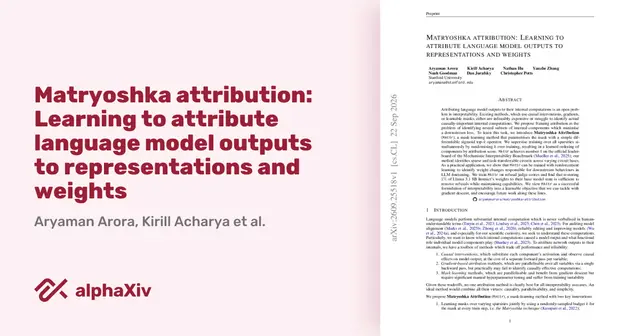
Matryoshka Attribution identifies weights linked to model behavior
In a post published on September 28, 2026, Matryoshka Attribution is presented as a technique for ranking neural representations and weight changes by their influence on behavior.
- RAG and retrievalPaper
MaxSim and the capacity to represent inner products
An article dated July 8, 2026, shows that MaxSim can exactly replicate inner products between nonnegative k-sparse vectors, providing a theoretical basis for late-interaction retrieval systems.
- Attention and model architecturePaper
Megalodon and long-sequence evaluation
An article published on September 24, 2026 presents an architecture based on Mega, designed for efficient pretraining and inference with unlimited context.
- AI agentsPaper
MemoHarness adapts agents using execution history
Published on July 17, 2026, the work presents a method that adjusts six dimensions of an agent harness using prior executions. On a shell-agent benchmark, it scored 0.806, compared with 0.722 for the strongest fixed-harness baseline.
- Attention and model architectureArticle
Shared memory reduces memory use in recurrent Transformers
An article published on October 5, 2026 reports a 76–79% reduction in context memory and improved quality in models with 150 million to 1 billion parameters.
- AI agentsPaper
Agent memory with a frozen model
In a post published on August 26, 2026, Recuris describes two memory loops and a fixed meta-agent that proposes repairs based on execution traces, without changing model weights.
- Attention and model architecturePaper
Sparse memory expands RNN state without raising compute per token
Published on July 11, 2026, the post describes Sparse Delta Memory, which combines an RNN with explicit sparse-addressed memory to increase state capacity while keeping compute per token constant.
- CUDA and GPU programmingArticle
Heterogeneous memory: compiler capacity checks
In a post published on September 28, 2026, Vx describes a machine model based on capacity, connections, and visibility, and reports two capacity errors found on a laptop without a GPU.
- Attention and model architectureArticle
Token-indexed memory changes attention in Transformers
A post published on September 25, 2026 describes an architecture that sums contextual keys and token-indexed, layer-specific memory vectors, and allows the memory to reside in CPU memory.
- AI agentsPaper
Proactive memory for long-horizon agents
A paper describes a separate memory agent that maintains structured records and decides when to present reminders to an action agent. The approach was evaluated on Terminal-Bench 2.0 and tau-squared-Bench.
- AI agentsPaper
Recurrent memory for long-context agents
A paper published on September 29, 2026 identifies retention as a bottleneck in recurrent-memory agents and presents a training-free approach that selects one memory head and preserves the others.
- Attention and model architecturePaper
Memory Attention proposes token memory for calculating values
In a post published on September 25, 2026, Memory Attention combines layer-specific token memory with contextual keys to form attention values, with potential KV cache reduction and CPU offloading.
 arxiv.org







Let's assess your project

I reply with scope and a proposal.